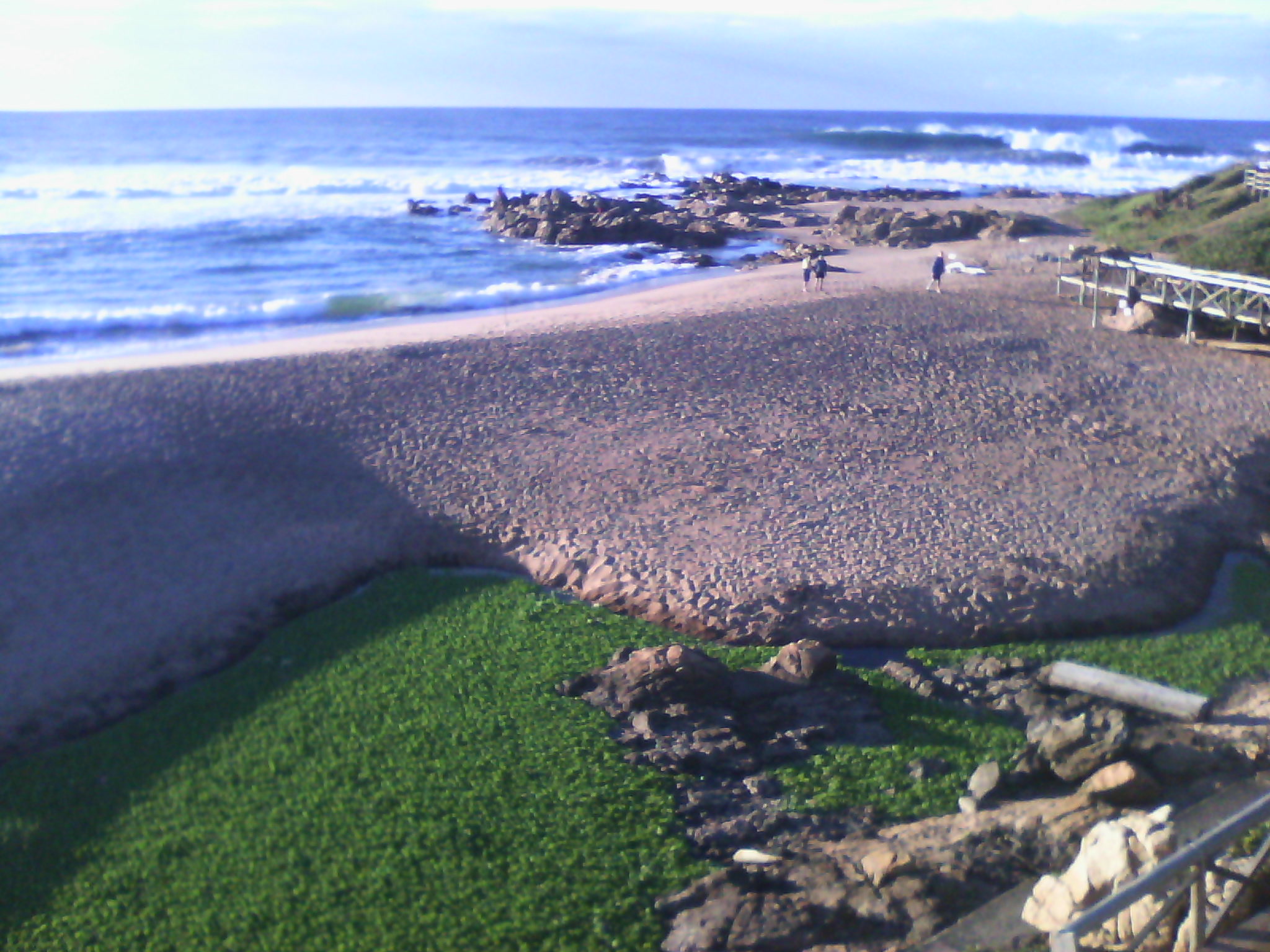
An early morning surf check at Banana Beach on the lower south coast of KZN, saw the entire, once functioning and beautiful estuary completely throttled by a water hyacinth species. Not one square foot was open to the early morning sun. And the tiny fish that were left were grappling for a breath in amongst the tightly packed floating plants. The bigger mullet had long since jumped onto the rocks and surrounding beach, as they desperately jumped in search of a last minute reprieve, a known mullet behaviour.
As the astounded crew of surfers descended for a better look, it was discussed that not even two weeks ago, the hyacinth only occupied only the end corner of the river, and some on the edges along both sides.
Roosta literally dived in to clear some space for the remaining little fish to swim and breathe. As he was clearing space he was rescuing upside down but still breathing grunter, mullet, bream and mullet. And ran them into the shore break to hopefully air up and survive.
The Environmental Affairs crew cleaning the beach, gave us the number of their supervisor, who said she would call us back in after speaking to her boss. We asked for permission to assist, and this afternoon are returning with ropes and rakes to what we can. The only thing we can do in the meantime is clear the stuff manually.
Build it in Hibberdene and Highlands glass made the first contributions…

On Sunday morning we are going to try again. Please consider joining us, it’s going to be a monumental task. There are tonnes of hyacinth to remove. It is going to be deposited in the carpark for removal. Wheelbarrows, rakes, ropes, sacks etc…
In the meantime, at Rock Bottom on Saturday…from 5pm, Roost a and the Gubat Soldiers will be playing their surf funk rock punk collection of treffers, to raise awareness, make a plan.
The following link gets you to the South Coast Sun’s report on the Army Saints who are also voluntarily clearing the Amazimtoti river. The report is dated the 4th of June 2014!
southcoastsun.co.za/38783/saints-get-stuck-into-river-hyacinch/
Then a final, and positive finding. It appears that hyacinth absorbs and processes sewage! So at the end of all this, we may have a crispy clean river again. It will take years of effort and resources to return our rivers to their original state…the state that they need to be in again to function as spawning and breeding grounds for so many of our fish species.
But these first measures are a start. We would also like to appeal to experts in the field to jump in with advice and direction. At this point it seems obvious that physical removal is an obvious and innocent start, but as we further try assist, as the public, it would be prudent that we got to the right information.
Some information from Wikipedia…
”Phytoremediation, waste water treatment
The roots of Eichhornia crassipes naturally absorb
pollutants , including lead , mercury , and strontium-90 ,
as well as some organic compounds believed to be
carcinogenic, in concentrations 10,000 times that in
the surrounding water. [27] Water hyacinths can be
cultivated for waste water treatment. [2]
Water hyacinth is reported for its efficiency to remove
about 60–80 % nitrogen (Fox et al. 2008) and about
69% of potassium from water (Zhou
et al. 2007). The roots
of water hyacinth were found to remove particulate
matter and nitrogen in a natural shallow eutrophicated
wetland (Billore et al. 1998). [28]”
See you Sunday!