The Predators Become the Prey — A Sardine Run Orca Encounter by Elton
The Predators Become the Prey — A Sardine Run Orca Encounter by Elton: I’ve spent enough years on the Sardine Run to know that success rarely comes from luck alone. Starting out as a Sardine Run Dive Master back in 2012, i was lucky enough to find a spot on a boat and learn from a skipper who had not only been on the Sardine Run – He understood it.
People often think the Sardine Run is just about finding birds and racing over to them, but the reality is that watching the ocean, its animals, its currents, actually watching it, questioning it, trying to understand the bigger picture, thats what its about.
Sometimes the difference between an average day and a once-in-a-lifetime encounter is simply being in the right place at the right time and that’s something experience teaches you.
Just Another Sardine Run Day
This particular day started just after launching from Cintsa on the Wild Coast during one of our Go Dive Sardine Run expeditions.
Not long after the launch, my friend Shane called to say there was a good pod of dolphins and some gannets working out in front of the IDZ near East London.
After a quick scan of the horizon, I remember thinking this might be one of those days where we needed to burn a little extra fuel and search a wider area than usual and we set off for East London
On the Sardine Run, a good pair of binoculars is one of the most important pieces of equipment on the boat. Without ours, we probably would have missed the small cluster of distant gannets that eventually led us toward the dolphins Shane had seen earlier that morning.
When we finally reached them, it was a pod of roughly 300 common dolphins spread out over a fairly large area and first they didn’t appear to be hunting sardines at all.
Instead, they were repeatedly breaking into smaller groups to feed before reforming back into the main pod. That’s very typical behaviour when dolphins are feeding on other bait fish like mackerel or needlefish rather than sardines.
We spent quite a while slowly tracking alongside them as they moved eastward back toward Cintsa. We even slipped into the water for a snorkel at one point, although the dolphins seemed fairly uninterested in us.
As we motored slowly alongside the pod, I suddenly thought back to another Sardine Run a few years earlier when we’d encountered a dolphin pod moving fast, tightly grouped and clearly under pressure. Later that day we discovered orcas had attacked and killed one of the dolphins from that exact pod.
That memory suddenly popped into my head while watching these dolphins and I remember casually saying to the crew:
“Just remember… at any point these predators could become the prey.”
Everyone laughed because the comment was half serious and half joking but less than five minutes later I looked back and saw two large black fins disappearing behind the pod.
For a second I just froze.
I remember standing there with my mouth open trying to process what I’d seen.
I told the crew and clients to help me watch for another surfacing while my brain replayed the image over and over, questioning whether I’d imagined it.
But I knew what I’d seen.
I’m no stranger to orcas. I’ve witnessed several predation events over the years, including one involving a white shark near Seal Island in Mossel Bay.
Then suddenly they surfaced again.
Two massive black fins cutting cleanly through the water.
At exactly the same moment, the dolphin pod realised the danger behind them.
Everything exploded.
Three hundred dolphins instantly accelerated into full panic mode trying desperately to outrun the approaching orcas.
It’s one of the wildest things I’ve ever seen on the ocean.
People imagine dolphins leaping dramatically high into the air, but when dolphins flee predators they move differently. They launch themselves low and fast across the surface, surging forward five or six metres at a time.
The ocean becomes white water, spray and chaos.
You can hear the panic.
My own heart was racing just as fast.
At that moment I was trying to do ten things at once — predict where the orcas would surface next, position the boat correctly, grab my DSLR camera, prepare the drone, keep track of the dolphins and somehow still absorb what was unfolding around us.
But while following the fleeing dolphins, something suddenly felt wrong.
Where were the orcas?
They hadn’t surfaced again.
They definitely weren’t still chasing.
And that could only mean one thing.
They’d already made the kill.
I instantly throttled back and stopped the boat.
Everyone onboard looked confused as the dolphins disappeared into the distance ahead of us. Surely following them gave us the best chance of finding the orcas again?
But years on the Sardine Run told me otherwise.
If the orcas had successfully isolated a dolphin, they would likely remain behind to drown and feed rather than continue chasing the pod.
So we waited.
And waited.
That minute honestly felt endless.
Then suddenly one of the orcas surfaced barely 20 metres from the boat before immediately diving deep again.
That confirmed it.
They were taking turns holding the dolphin underwater.
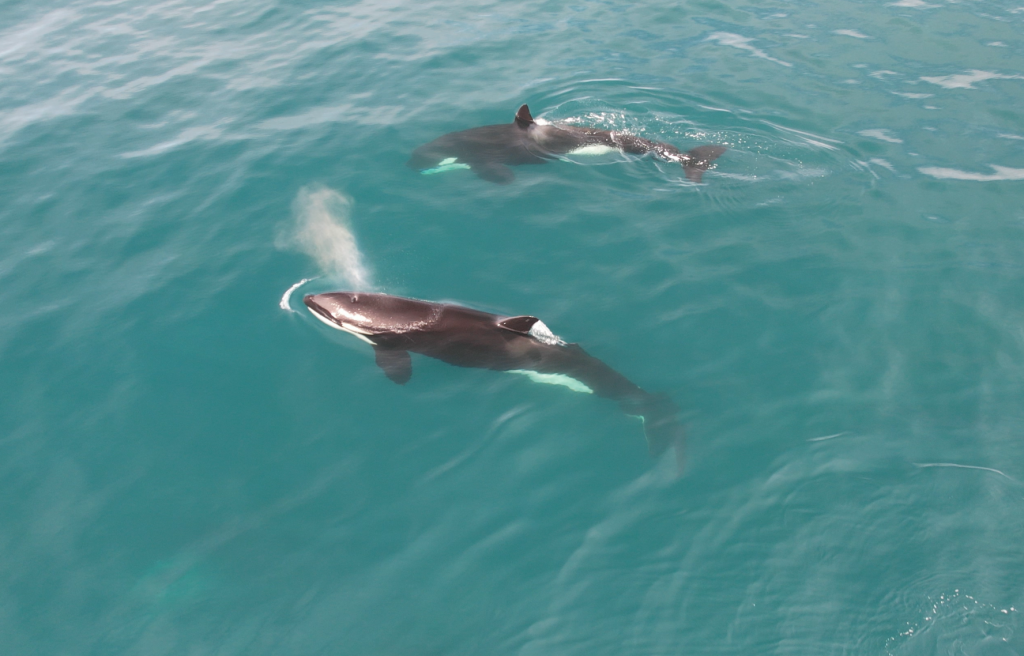
Over the next few minutes, three more orcas appeared until we could clearly see the full pod — three adults and two sub-adults.
For the next twenty minutes we watched them surface one by one to breathe before disappearing back into the depths.
That was my chance to get the drone in the air. Watch the video here.
Watching the footage afterward was unbelievable. At times you could clearly see different individuals feeding from the carcass while others circled below. Eventually the feeding stopped, but the orcas didn’t leave.
For almost two hours we simply drifted in the ocean alongside these incredible animals while they surfaced randomly around us, either alone or together, calmly digesting their meal with absolutely no urgency to leave.
One of the things I love most about the Sardine Run around Cintsa is how wild it still feels.
Unlike some more crowded Sardine Run areas, we often experience these moments with very few other boats around us. There are no queues, no pressure and very little interference with the animals.
Just raw nature unfolding naturally.
I honestly believe that’s part of what makes our little stretch of the Coast so special.
The combination of deep water, migrating bait fish and relatively low boat traffic seems to create incredibly natural predator behaviour.
For operators like us at Go Dive Mossel Bay, that’s exactly what we search for every day during the Sardine Run.
Not just bait balls.
Not just action.
But real, authentic wildlife encounters where experience, patience and understanding of the ocean place you in the right position when something extraordinary happens.
Eventually the orcas slowly dispersed and vanished back into the deep.
And we pointed the boat back toward Cintsa completely silent for a while, each of us trying to process what we’d just witnessed.
The funny thing about the Sardine Run is that no matter how many years you spend out there, the ocean still finds ways to surprise you.
Blow bubbles and forget your troubles – we will see you soon
Facebook Instagram Youtube Tiktok
Get In Touch
Sardines and Sighting Maps
Here are the links to existing and past Sardine Sighting Maps. With instructions on how to install The Sardine News right on your phone, tablet, or even desktop.
Channels
Brucifire Surf Retorts – highly entertaining surf reporting
Master Watermen – news from way down deep
The Sardine News – neva miss a single sardine
FishBazaruto – 1000 pounds plus
MYDO Tackle Talk – highly technical sport fishing
Surf Launching Southern Africa – getting out there safely
Water Woes – complain about your municipality here
Websites
umzimkulu.co.za – fishing, charters, accommodation
umzimkuluadrenalin.co.za – will get you right out and onto the edge
thesardine.co.za – never miss a single sardine
masterwatermen.co.za – news from under water
fishbazaruto.com – dreams are out there
brucifire.co.za – surf retorts
fishmad.co.za – destination Madagascar
andantelodge.co.za – Transit luxury in Pretoria