
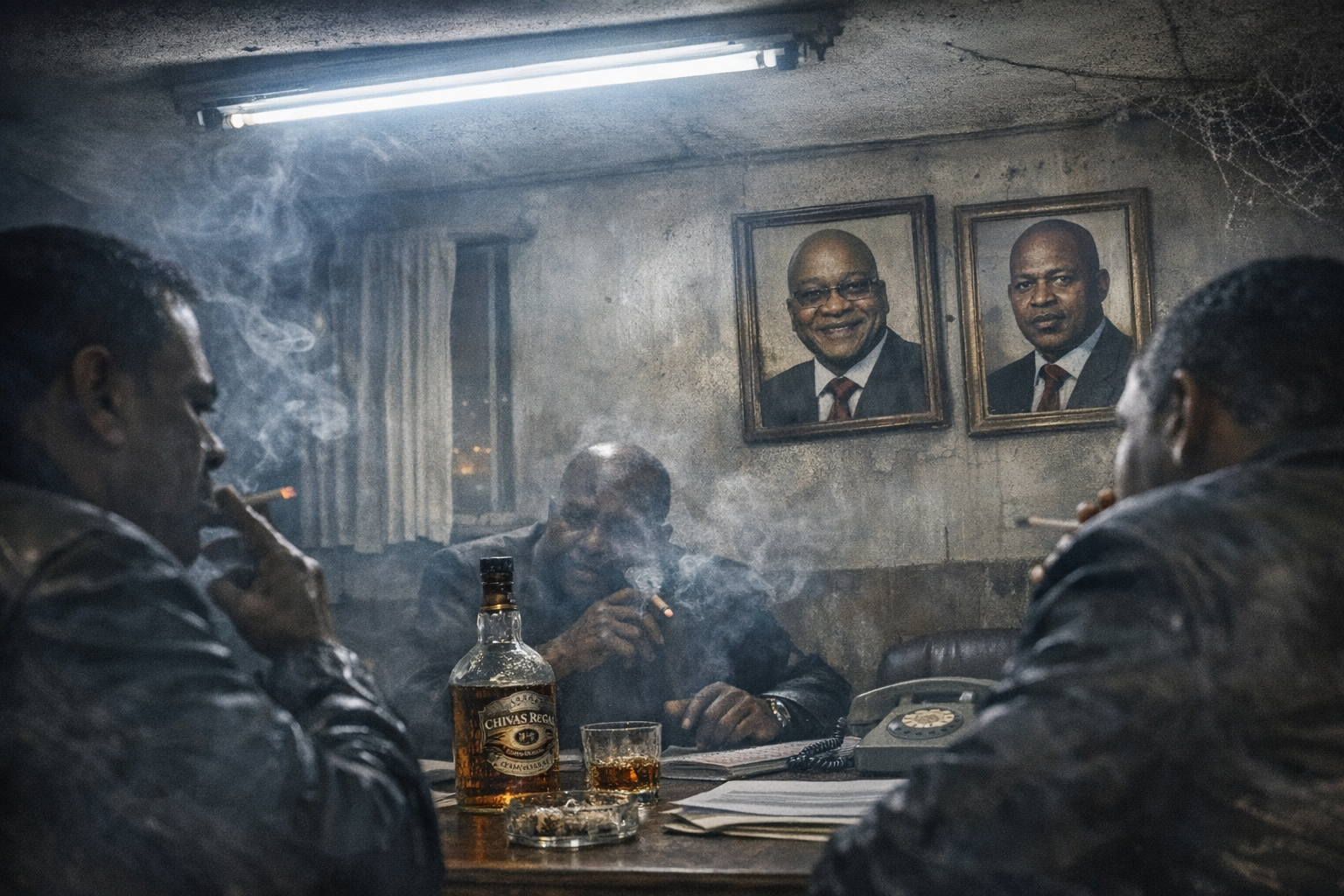
The Anatomy of a Water War
The Anatomy of a Water War: The air in the room is thick with cigarette smoke, made surreal by the flicking light of an about-to-die fluorescent tube. The air conditioner pounds with the rhythmic throb of a horseman, riding through the swirling mists of danger, on an important secret mission. The voices are hushed and conspiratorial as the men huddle under the omnipresent gaze of the President and Minister, dutifully hanging in picture frames from the wall, each at a slightly offset angle and pitted with a fine matt of fly excrement. The government building cries out for a lick of paint, the grubby ceilings now home to a fine web of spider silk and entrapped grime. The elevators no longer work, and the stairwell bears all the signs of heavy traffic and the absence of a coherent maintenance plan.
But nobody notices.
Outside the daily life of Pretoria is played out on the streets, as citizens shuffle along in blissful innocence. The cars grind their way through the streets of the city, congested because of the traffic lights that have failed yet again. A small vortex of wind dances along the pavement, rattling the detritus in the gutters of the grimy street. The jacaranda trees are in full foliage, but their vibrant flowers have long been shed, abandoning the city to its grey socialist uniformity once again. The streetlamps have bare wires hanging from their bases, disembowelled by metal thieves scavenging for a pitiful existence in the city that once held so much hope. The statue of a heroic past leader on the grassy park leading up to the Union Buildings is fouled with bird scat. The lawns need the manicure of a competent gardener, no longer present because all workers have become managers, and no managers want to work, for that is the way of socialism.
Inside the room, the men speak in staccato, voices clipped but urgent. The topic of discussion is the need to consolidate power after Mangaung[i]. The stakes are high. The ruling African National Congress (ANC) is under pressure, most notably from the Democratic Alliance (DA) and the recent defection of the AbaThembu King Dalindyebo. A coherent strategy is needed, and this is the purpose of the meeting.
The Chivas flows because the brain needs lubrication. This is out-of-the-box thinking at its best. A socialist revolution that has ground to a halt needs to be revived once again. The champion of that revolution – Jacob Zuma – has just been re-elected as the President of the ANC, but he is being attacked by counter-revolutionary forces that must be stopped at all costs.
One of the men speaks with disgust as he recounts the way that Msholozi[ii] was humiliated by that “white capitalist Jew” Helen Zille. His words are ejected like the venom from the curled lips of an mFezi, the Zulu name for a spitting cobra.
“It’s unacceptable”, he says. “That umThakathi (witch) is ignorant of our culture, even if she speaks isiXhosa. She is a woman speaking about the things of men. She has no right to do this. What does she know of a man?”
Under discussion was the attack on Jacob Zuma led by Helen Zille when a letter written by her to the Cape Argus was leaked by her staff to the Sowetan in May 2009[iii]. That letter was a feisty response to the ANC over attacks on her as the newly elected Premier of the Western Cape. For whatever reason, Zille chose to have an all-male provincial cabinet, and this was being ridiculed[iv]. Flushed with the recent victory of the DA in the Western Cape[v], she sailed forth like a magnificent ocean-going clipper, spinnaker unfurled before the strong but predictable Trade Winds. Her attack was escalated in the ensuing war of words after the Sowetan published the leak. They aimed it at the heart of the majority, triggering deep-seated cultural sensitivities, when Zille ramped up the rhetoric by accusing Msholozi of being an irresponsible womaniser [vi]. She attacked him relentlessly, accusing him of putting his many wives at risk by having unprotected sex with a woman known to be HIV positive. She made a strong statement when addressing a conference on wellness hosted by the Western Cape Health Department, calling for the criminal prosecution of men who knew they were HIV positive, but persisted in having unprotected sex with women without declaring their status[vii].
Activists and legal scholars were alarmed at the tone of the rhetoric, releasing statements of their own. Among them were Professor Pierre de Vos[viii], a highly respected constitutional law scholar, and Mark Heywood[ix], a prominent AIDS activist.
This was a very sensitive issue indeed[x]. The whole Zuma rape trial was deeply humiliating, not only for the man himself, but also for the military veterans and the ANC. Zapiro, the famous South African cartoonist, had a field day, producing his now signature theme of the shower head. This was amplified by the statement made in court by Zuma, that he bathed himself after having sex with the unfortunate woman, so he was not at risk[xi]. The Umkhonto we Sizwe Military Veterans Association (MKMVA) was quick to rally to the call of their Commander in Chief, making a statement that it would launch a political program that rendered the Western Cape ungovernable[xii].
But nobody took them seriously.
The conversation in the room was now free-flowing, unlike the traffic in the street outside, grinding its way through peak hour gridlock, confused drivers unable to interpret the meaning of a red and green light simultaneously, a bewildering concept increasingly evident when the lights sometimes worked. The Chivas was better than any high-octane fuel in a Formula One racing engine. The men were being inflamed by a virulent fever, as the conversation shifted like the restless tides of a great ocean. That tide was about to unleash a tsunami of unprecedented destruction, in a modern-day Mfecane[xiii] not dissimilar to that which accompanied the first stirrings of Zulu nationalism two centuries ago.
Another man spoke in a trembling voice, rising above the murmur in a growing crescendo of anger.
“That woman is like iGwalagwala (Purple Crested Lourie) strutting around in fine clothing, making a noise that insults our ears. She is worse than Inhleka bafazi[xiv]”, the Zulu name for the Red Billed Hoopoe that literally means “chattering women”.
Unaware of the profound sensitivity that she had just invoked, Zille sailed forth undaunted, with renewed vigor after this feisty engagement. Eager to show that she was cut from the cloth of true leadership, she now had a head of steam so powerful that she believed she was invincible[xv]. Responding to the transfer of a large tract of land in the Western Cape to the national government, Zille accused the ANC of asset stripping[xvi]. Lynne Brown, later associated with the plunder of almost all State-Owned Enterprises (SOEs) under her control as Minister of Public Enterprises, through the Gupta-led criminal syndicate pivoting around Jacob Zuma, signed the documents on 21 April 2009[xvii]. This was the day before the elections that saw the spectacular sweep to victory by the DA in the Western Cape.
The DA, like Rommel’s mobile panzer force, now fueled by euphoria from its own victories, was apparently becoming invincible.
This was not to be tolerated, because the disputed land was later returned to the Western Cape provincial government[xviii], but the wounds had been inflicted and they ran deep. For Radical Economic Transformation to succeed – code for the self-enrichment by a small elite within the upper echelons of the ANC – Zille had to be destroyed.
Undeterred, Zille was now a woman on a mission, like the Iceni warrior Queen Boudica, flailing her way through a melee of Romans at the Battle of Camulodunum in 61 AD[xix]. Lashing out left and right, she went on the rampage, deep into the heart of traditional male cultural sensitivity. Blinded by her own sense of self-importance, ignoring her own knowledge of Xhosa culture, not dissimilar to that of the Zulu, she sought to unite all opposition against the single enemy in the persona of Jacob Zuma.
Traditional culture between the amaXhosa and amaZulu is similar, except in one key area. For a Zulu, manhood was achieved only after he had been in battle[xx]. During the reign of King Shaka, when the various Nguni clans were forged into one mighty Zulu nation, at least as significant as that of Napoleon, this meant bathing the iXwa[xxi], the short stabbing spear, with blood[xxii]. The returning warrior was referenced by members of his iMpi, a basic unit of combat, acting as a coordinated part of an iButho, a larger battle formation, and was now allowed to don the head ring known as umQhele, the visible symbol of a warrior who had been blooded in battle. Individual acts of courage were recorded in regimental song, while rare acts of cowardice were punished, to serve as examples of unmanly behaviour [xxiii]. For a Zulu, the rite of passage from iNsizwa – a youth not yet permitted to marry – to that of a man is sacred. So deep is this traditional custom rooted that the young warriors yet to be bloodied in battle wore the iPhovela, a visible headdress for those who had not yet been in combat. Truly brave warriors were awarded the isiQu, a necklace proudly given by the King to elevate the stature of the warrior significantly.
In more modern times, this was less explicit but still revolved around the act of proving manhood. The important aspect of all this is that in Zulu culture, manhood is earned, so it is intolerable that a woman should challenge this so openly and remain unpunished.
In Xhosa culture, the transition into manhood occurs when he is circumcised in a secret traditional ritual. When this happens, the man is expected to show no pain. The major difference is that for a Zulu, the symbol of manhood is visible, whereas for a Xhosa, it’s private. Therefore, to attack a Zulu man in such a public way is a deeply offensive action, made all the worse when it comes from a woman. Is it possible that Helen Zille, being a woman, was simply unaware of this subtle, but important, element of traditional culture? Then, to make matters worse, there was the erosion of the traditional leadership of the AbaThembu by the DA, which strikes at the very heart of the narrative of the Armed Struggle on which the present-day ANC’s legitimacy is based.
The Western Cape simply had to be rendered ungovernable.
This is something the ANC knew how to do, because it is the way they had swept through the country in the 1980’s. It is also exactly how the Zulu iMpi’s had subjugated all before them during the Mfecane[xxiv] that forged them as a proud nation.
The objective was now clear to the group, even as the road rage on the gridlocked streets outside the window was fueled by unbridled anger. To meet this objective – destroying the DA by making it ungovernable – a clear strategy was needed. To this endeavor the group now shifted their full attention.
“The iMpi was most successful when it went to battle in formation. This is what we must do. Our culture is our shield. We must honour our ancestors to restore the dignity of Msholozi. Remember the Battle of Gqokli Hill”, said the one man, now almost delirious from the potent cocktail of Chivas, conspiracy and creativity.
And so, the strategy was born of deep cultural tradition. That strategy was eloquent in its simplicity. The triumphant Shaka destroyed all before him with a simple military formation[xxv], and this is war. That formation was known as iziMpondo Zenkhunzi – the horns of the bull. In modern military parlance, this is called a pincer movement. The strategy was therefore to launch two actions simultaneously, guided by one clear objective – to make the Western Cape ungovernable and sweep Helen Zille from power in an act of humiliation at least as great as what she had inflicted on Msholozi.
The one part of the pincer movement was the systematic deprivation of any water infrastructure, building on the central lesson learned during the Battle of Gqokli Hill[xxvi] in April 1818. The other was to encourage the inward migration of people, typically loyal to the ANC. The first would bring the leadership to their knees, and the second would overwhelm the weakened population in an election, for after all South Africa is a democracy.
Water suddenly became a powerful weapon when the South African Water War was conceived by embattled Zuma loyalists, anxious to reignite a stalled socialist revolution, in a government building in 2013, with just a little help from Chivas Regal, the decadent trapping of capitalism.
This series of events ultimately pitted Zuma against the Zille / de Lille combination in a bitter battle that played out over a decade. This culminated in the total victory against white monopoly capital in 2014, when South Africa transitioned into a net foreign direct investment (FDI) deficit[xxvii], of a magnitude not even seen in the darkest days of Apartheid, when sanctions were at their peak. The Zille / de Lille “team” represents the values of a liberal democracy, based on the rule of law with external legitimacy of an international nature; while the Zuma “team” represents the values of traditional autocracy, having total disregard for the rule of law, relying on internal legitimacy of a tribal nature. The former is modern, the latter is traditional. The former is about service to society, whereas the latter is about hijacking the machinery of state to enrich the political elite, underpinned by a virulent client-patron relationship. The former is outward-looking and is all about globalism, whereas the latter is inward-looking based on tribalism and cadership. It’s therefore logical to believe that Zuma had every reason to seek revenge against these two women, just as its logical to accept that his response would be derived from the rich oral history that defines his tribal identity.
Being a deeply traditional man, Zuma fell back onto the only compass he knew – Zulu culture; and central to that belief system is one key event that shaped the Zulu nation – the Mfecane[xxviii].
So, what exactly was the Mfecane, given that it is no longer taught at schools or spoken of in polite company?
The translation of the word Mfecane, and its various derivatives, is truly revealing[xxix]. If you were on the side of the Zulu iMpis, then the word means “crushing”. If, on the other hand, you were on the side of the victims, then it meant something different. In the Sesotho language, the word is Difaqane, which means “scattering”, “forced dispersal” or “forced migration”. I was once working in Botswana when a large dust devil, typical of arid regions, danced across the Kalahari. On seeing this, a Tswana-speaking colleague said that the local word for such a thing is linked to the cultural experience of the Difaqane[xxx], so deep is the experience seared in the collective memory of the victims generations later. He explained that the dust devil sweeps across the landscape, like a focused eye of destruction, exactly as the Mfecane did two centuries ago.
To understand the Mfecane[xxxi], we need to travel back to what was then tribal territory, between the Pongola and Thukela Rivers, because it is here that the story begins[xxxii]. Dispersed over a large area of land were many clans, each speaking dialects of the Nguni language, but identifying only with their clan leaders. Conflict between the clans was common, the rite of passage into manhood being defined by a successful cattle raid. Within these clans, there were three significant ethnic groups – Ngwane, Ndwandwe and Mthethwa. The original Zulu speakers were the Ndwandwe, numerically the minority, living in present-day Mpumalanga and Swaziland. The Mthethwa were living near the Thukela River.
In the early 1800’s, probably around 1817, Chief Dingiswayo of the Mthethwa entered an alliance with the Tsonga people. They controlled the lowlands around Delagoa Bay, present-day Maputo, and were thus in contact with both the Ndwandwe and the Mthethwa. In the late 1700’s the Portuguese introduced maize into the Delagoa Bay area, the use of which rapidly spread inland[xxxiii]. Half a century later maize had reached the Zambezi River basin. Wherever maize went, it changed the nutritional base of society[xxxiv], but it also required more water. In 1800 there was a regional drought that triggered the Mahlatule famine, creating competition between water, cattle and maize[xxxv]. Maize thus meant a comparative advantage to the group that controlled it, but water was needed to unlock that advantage. Water became a critical variable in the journey of Zulu nationhood. The availability of maize started to impact the social structure of the region, so access to the supply became critical. This is what drove the Mthethwa/Tsonga alliance.
The Ndwandwe were pastoralists moving their herds along the valleys of the eastern highveld. Living on the tops of the mountains surrounding those valleys, was a large population of San. Unlike the hunter-gatherers that one typically associates with the San today, these people lived in stone houses, constructed out of the sedimentary rock found in the area between present day Ermelo and Carolina in Mpumalanga. This was the last haven for the San in Southeastern Africa. Central to that area is Chrissies Meer, a large wetland surrounded by 270 lakes, but underlain by coal. During the San era one group – the Tlou’e’thle – became fishermen living on floating homes safe from marauding clans. This fact was captured in the classic study, The Disappearing Bushmen of Lake Chrissie[xxxvi]. The Nguni name for these people was Abathwa, which means “small people”. The mountain dwellers used to raid the Ndwandwe cattle, so one day a decision was made to find a permanent solution. A raiding party was sent into the highlands to obliterate the Abathwa, who were unable to recover as a viable social group after this event. This gave a foretaste of the payoff arising from warfare based on ethnic cleansing. With that one single action, the Xegwi language that had prevailed for at least 1,500 years disappeared off the face of the earth. In 1927 Dorothea Bleek published her seminal work[xxxvii], The Distribution of Bushman Languages in South Africa, in which she recorded this fact[xxxviii]. To better understand the significance of this single event in the context of our current narrative, this took place only two centuries ago. Most South African’s are totally oblivious to this fact, just as most have never heard of the Mfecane. All that remains today are artifacts like the Legoya Huts in a UNESCO Heritage Site, known only to a few cultural tourists and anthropologists, but mostly forgotten inside South Africa.
The origins of Zulu nationalism start with the Mthethwa / Tsonga alliance, pitting Chief Dingiswayo of the Mthethwa against Chief Zwide of the Ndwandwe. In a series of bloody battles over access to trade routes from Delagoa Bay, the Ndwandwe initially prevailed. Chief Zwide of the Ndwandwe killed Chief Dingiswayo of the Mthethwa, but in so doing evoked a deep alliance with Shaka, not yet the recognised leader of a coherent nation. Dingiswayo was a mentor to the young Shaka, having given refuge to his mother, Queen Nandi, so the memory of this ran deep with the future warrior king[xxxix]. When Dingiswayo was murdered by Zwide in 1817, Shaka sought revenge. In a cat-and-mouse game that ensued, Shaka killed Ntombasi, a sangoma (shaman) and mother to Zwide, by locking her in a hut with hyenas, burning what remained the next day.
At the Battle of Gqokli Hill[xl] in April 1818, Shaka continued his relentless attack on the Ndwandwe. It was at this battle that the practice emerged of killing all men, while giving women the choice of either being assimilated, as future mothers of Zulu warriors, or being put to the spear. But the Battle of Gqokli Hill[xli] is significant for another reason, for it was here that the first evidence of Shaka’s command of tactics and strategy can be traced. Hopelessly outnumbered, Shaka sent a series of skirmishing parties to delay the advancing Ndwandwe[xlii]. The terrain dictated that the Ndwandwe army had to cross the White Umfolozi River, so Shaka’s skirmishing parties were ordered to delay their advance, knowing that the high flow of the river would be a defensive advantage. In preparation for the battle, Shaka moved his non-combatants and women into the safety of the Nkandla[xliii] forest – present-day home to Jacob Zuma – and thus deeply ingrained in his cultural identity. In a brilliant reading of the terrain, Shaka placed a small force on the top of the hill to attract the advancing Ndwandwe into what appeared to be an easy victory. Shaka then placed his main force in a depression just over the ridge of the hill, poised to strike the instant that the Ndwandwe were unable to retreat, but also with stores of food and water to keep the fighting force combat-ready. In an act of tactical genius, Shaka dispatched a highly visible force, the Nkomendala regiment, along with many cattle, to create the illusion that he was fleeing, in the hope that the Ndwandwe would split their main force, then crossing the Umfolozi River[xliv]. The Ndwandwe General Nomahlanja, Chief Zwide’s oldest son, took the bait, dispatching four regiments to engage what he considered to be the fleeing force on the southern bank of the river.
With his reduced force of 8,000 men, Nomahlanja engaged in an uphill battle, where once again the tactical brilliance of Shaka was revealed. The Ndwandwe had long throwing spears, known as isiJula, which they were unable to use effectively in the crowded battle space. Shaka had introduced the shorter iKlwa, a weapon like the Roman gladius, which was ideal in close combat with a small unit of highly disciplined warriors, collectively using their shields as protection from flying spears. The name is derived from the sucking noise made when withdrawing the sword from the viscera of a slain enemy combatant. In the heat of battle, no less than five counter-attacks were launched by the thoughtful General Nomahlanja, during which a vital tactical factor became evident. The Ndwandwe became thirsty, having drunk whatever water they were able to carry on their advance to battle, so increasingly large parties of exhausted warriors were seen retreating to the Umfolozi River to draw water. The wily Shaka had anticipated this and stored a significant supply of water with his reserve force hidden in the depression of the hill.
During a day of heavy fighting, under a hot African sun, water became tactically relevant.
Nomahlanja incorrectly assessed the situation by concluding that both sides were taking casualties, believing that the Zulu forces must be as thirsty as the Ndwandwe were, so he launched one last counterattack. A force of 1,500 warriors was dispatched in battle formation, including the elite amaNkayia, to engage what he thought was a diminished force of 500 Zulu warriors. Shaka had been using four of his six regiments, the amaWombe, uDlambedlu, uKhangela, and Jubingwaqa, all now depleted by a day of vicious close combat. It was at this moment that he unleashed his elite uFasimba and iziCwe regiments, kept out of sight and freshly hydrated, but spoiling for a fight. With the rout of the main Ndwandwe force underway, Shaka no longer had the need for his fighting reserve, so he dispatched the Jubingwaqa regiment to deal with the small force chasing down the decoy band of Nkomendala warriors[xlv], and their cattle on the southern bank of the Umfolozi. In a mopping-up action, both the uFasimba and iziCwe regiments destroyed the remaining Ndwandwe warriors on their way to collect water.
The control of water played a decisive role in the first significant battle of the Mfecane, and this became part of the Zulu oral history at that moment. This fact was seared into the mind of Jacob Zuma, who has always been profoundly aware of the significance of the Nkandla Forest in the creation of the mighty Zulu nation. As a small boy he was educated in that oral tradition by old warriors who had either been part of that great battle, or who were the sons of warriors that had been at that battle. This single fact is pivotal in understanding the South African water war, which was conceived in a government building in Pretoria in 2013 but had its genesis in the Battle of Gqokli Hill in April 1818. To guarantee the value of the element of surprise, the plan had to be kept secret, for cunning is as powerful as might.
Thank you, Tony! – Xonalanga
Sardines and Sighting Maps
Here are the links to existing and past Sardine Sighting Maps, with instructions on how to install The Sardine News right on your phone, tablet, or even desktop.
Channels
Brucifire Surf Retorts – highly entertaining surf reporting
Master Watermen – news from way down deep
The Sardine News – neva miss a single sardine
FishBazaruto – 1000 pounds plus
MYDO Tackle Talk – highly technical sport fishing
Surf Launching Southern Africa – getting out there safely
Water Woes – complain about your municipality here
Websites
umzimkulu.co.za – fishing, charters, accommodation
umzimkuluadrenalin.co.za – will get you right out and onto the edge
thesardine.co.za – never miss a single sardine
masterwatermen.co.za – news from under water
fishbazaruto.com – dreams are out there
brucifire.co.za – surf retorts
fishmad.co.za – destination Madagascar
andantelodge.co.za – Transit luxury in Pretoria