Matrics urged to celebrate safely around water this summer
Cape Town, 19 November 2026: The November 2026 Senior Certificate exams are almost over, with the final paper scheduled for Wednesday, 25 November. For many matric learners, the last exam will be Afrikaans Paper 2 on Friday, 20 November. In the days that follow, thousands of school leavers will head to beaches, rivers, dams and swimming pools to celebrate the end of their school careers.
The NSRI congratulates the class of 2026 on reaching this milestone and asks every matric to make water safety part of their plans.
Drowning can happen quickly and quietly. Every summer, NSRI volunteers, NSRI lifeguards and members of the public save lives along the coast and on inland waters. Too often, though, a celebration ends in a drowning that could have been prevented.
“You have worked hard to get here, and you deserve to celebrate,” says Andrew Ingram, NSRI Head of Communications. “The NSRI asks that you look after yourselves, your friends and loved ones around water. Make smart choices, swim where lifeguards are on duty and know who to call if something goes wrong. We want every one of you to start the new year safely.”
Alcohol vs Water
The NSRI’s first and most important message to matrics is not to mix alcohol and water.
Alcohol slows reactions, impairs judgement and coordination, and makes people overconfident. Swimming or boating after drinking is as dangerous as drinking and driving, and cold water, waves and currents are far harder to handle when intoxicated. The NSRI encourages groups of friends to agree before the party starts that nobody swims after drinking, and to look out for one another. Swimming alone, after dark or late at night after a party, should be avoided.
Some matrics may spend the holidays looking after younger brothers, sisters and family members, or working holiday jobs that involve caring for children.
The NSRI would like to remind everyone that drowning is silent. A child in trouble in the water rarely splashes or calls for help and can slip under quietly within seconds. Anyone responsible for a young child in or near water should stay within arm’s reach and put their phone away, because a drowning can happen in the time it takes to check social media or answer a call. “Never assume someone else is watching,” says Andrew. “And if you have been drinking, hand the job over to an adult who has not been drinking.”
At the coast, rip currents remain one of the biggest dangers to swimmers. These strong channels of water pull people away from the shore and are hard to spot, even for confident swimmers.
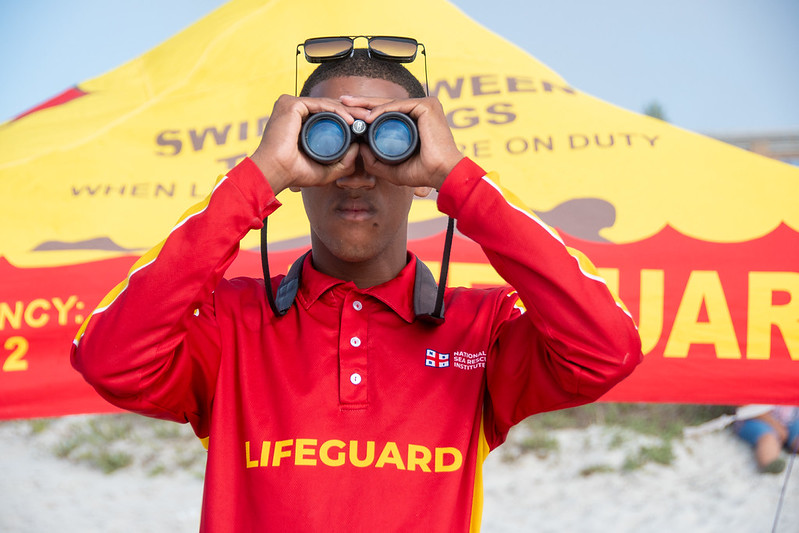
Lifeguards are trained to identify them, which is why the NSRI urges beachgoers to choose beaches where lifeguards are on duty and to swim between the red and yellow flags. Anyone caught in a rip current should not panic or try to fight it. Instead, they should float, wave for help, and swim parallel to the shore until they are free of the current, then head back to the beach. Anyone who sees someone in difficulty should call a lifeguard or the NSRI and throw the person something that floats.
Nobody should go into the water to help without a flotation device, such as a Pink Rescue Buoy or a surfboard. Too often, the person trying to help becomes a second casualty.
The Wet Season in KZN
In summer rainfall areas, heavy rain brings a different set of risks.
Storms can quickly turn rivers and streams into fast-flowing torrents, and water that looks shallow can be deep and powerful enough to sweep away a person or a car. Dam sluice gates may be opened without warning during heavy rain, causing sudden flooding downstream, and dams often have uneven floors with sudden deep areas. Nobody should try to cross a flooded or fast-flowing river, on foot or in a vehicle. Where a river is not flowing fast, and a crossing cannot be avoided, someone should first walk through using a stick to check the depth.
If a person is swept away or trapped in a vehicle, bystanders should not go in after them, but should call 112 and throw them something that floats.
Knowing who to call can save precious minutes.
In South Africa, 112 is a free emergency number from any mobile phone, and callers can ask to be put through to the police, ambulance, fire and rescue services or the NSRI.
The NSRI Emergency Operations Centre can be reached directly on 087 094 9774, and one call to this number can activate any NSRI rescue station in the country.
The NSRI asks everyone to save both numbers on their phones now, before they need them.
“Celebrate, have fun and make memories,” says Andrew. “Make sure everyone in your group gets home safely.”